
Thermocouple Cable
Thermocouple Cable Supplier
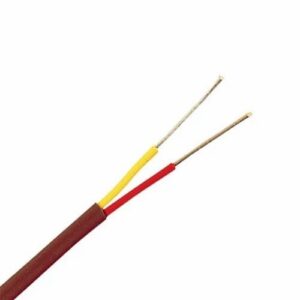
Thermocouple Cable: An Overview
Thermocouple cables are exactly the same to instrumentation cables. Both are used to measure process temperatures. The manufacturing procedure for these cables is comparable to National Agencies’ paired instrumentation cable, with the exception of the conductor material. Thermocouple cables are used for quantifying temperature. This in a wide range of applications. Thermocouple Cables are used to connect control surfaces to pyrometers, allowing for precise temperature indication and control, we sell Thermocouple Cables in quantity. We are one of the most renowned Thermocouple Cable Suppliers in Kolkata, West Bengal, Odisha, Bihar, Jharkhand, Chhattisgarh, and Assam. Thermocouple Cables are essential components in temperature measurement systems, acting as the connection between a thermocouple sensor and the measurement or control device. These cables are specifically designed to maintain the thermoelectric characteristics of the thermocouple over long distances, ensuring accurate temperature readings.
What is a Thermocouple Cable?
A Thermocouple Cable is constructed using materials that match the thermocouple type (e.g., Type K, J, T, etc.) and is used to extend the thermocouple signal from the sensor to the instrumentation. These cables are available in two main types: extension cables (EX) and compensating cables (CX).
- Extension Cables (EX):Made from the same materials as the thermocouple wires.
- Compensating Cables (CX):Made from materials with similar thermoelectric properties to the thermocouple wires but at a lower cost.
Key Features of Thermocouple Cables
- Temperature Range:Designed to withstand extreme temperatures based on the thermocouple type.
- Accuracy:Ensures minimal signal degradation for precise temperature readings.
- Durability:Resistant to environmental factors like moisture, chemicals, and mechanical stress.
- Shielding:Comes with shielding to minimize electromagnetic interference (EMI).
- Insulation Options:Available in various insulation types, such as PVC, PTFE, or fiberglass, for different environments.
Types of Thermocouple Cables
- Type K (Chromel-Alumel):Ideal for high-temperature applications, up to 1260°C.
- Type J (Iron-Constantan):Suitable for lower temperature ranges, up to 760°C.
- Type T (Copper-Constantan):Best for cryogenic applications, up to 370°C.
- Type E (Chromel-Constantan):Offers high accuracy at lower temperatures.
Applications of Thermocouple Cables
- Industrial Processes:Used in furnaces, kilns, and reactors for temperature monitoring.
- Aerospace:Essential in engine temperature monitoring systems.
- Automotive:Used in exhaust systems and engine diagnostics.
- HVAC Systems:For precise temperature control in heating, ventilation, and air conditioning.
- Food and Beverage:Ensures accurate temperature readings in processing and storage.
- Carbon composite curing for aircraft, aerospace, and various other industries.
- Autoclaves, furnaces, and ovens for multiple purposes.
- Heat treatment and annealing in the production of metals and metal parts of any kind.
- Forecasting accurately temperature measurement for medicinal products, chemicals, and petrochemicals.
Technical Specifications
| Parameter | Specification |
| Conductor Material | Chromel/Alumel |
| Insulation Material | PVC/PTFE/Fiberglass |
| Temperature Range | -200°C to +1260°C |
| Shielding | Aluminum/Mylar with Drain Wire |
| Outer Sheath | PVC or Stainless Steel Braid |
| Compliance Standards | ANSI MC96.1, IEC 60584 |
Benefits of Thermocouple Cables
- Cost-effective:Reduces the need for expensive thermocouple materials over long distances.
- Reliable:Provides stable and accurate signal transmission.
- Customizable:Available in various configurations to suit specific applications.
Quick Links
- Back Box Face Plate Supplier
- Lan Cable Supplier
- Green Cable Supplier
- Cat 6 UTP Cable Supplier
- Cat 6 Outdoor Cable Supplier
- Cat 6 SFTP Cable Supplier
- Cat 6 UTP Cable LSZH Supplier
- Cat 5e Cable Supplier
- 3+1 CCTV Cable Supplier
- Cat 6 Loaded Patch Panel Supplier
- Cat 6 IO Keystone Module Supplier
- Face Plate Supplier
- Thermocouple Cable Supplier
- Cat 6A Patch Cord Supplier
- RJ-45 Connector Supplier
- Optical Fiber Cable Supplier
- Lan Cable Accessories Supplier
- Rack 2U to 42U Loaded/Unloaded Supplier
- D-Link OFC 6 Core SM Armoured Supplier
- D-Link LIU 6 Port Rack Mount Unloaded Supplier
- D-Link for SC SM Simplex Adaptor Supplier
- D-Link for SC SM Simplex Pigtail Supplier
- D-Link for LC SM Simplex Pigtail Supplier
- Cat 6 Armoured Cable Supplier
- Shielded Cable Supplier
- Control Cable Supplier
- Rubber Cable Supplier
- Instrumentation Cable Supplier
- Telecommunication Cable Supplier
- House Wiring Supplier
- HT Cable Supplier
- LT Cable Supplier
- Flexible Cable Supplier
- Solar Cable Supplier
- HOFR Cable Supplier
- Elastomeric Cable Supplier
- Power Cable Supplier
- Coaxial Cable Supplier
- Unarmoured & Armoured Cable Supplier
- Fiber Optic Cable Supplier
- Submersible Cable Supplier
- Jelly Filled Telephone Cable Supplier
- Single Core Cable Supplier
- Copper Wire Cable Supplier
- Fire Survival Cable Supplier
- Multi Core Cable Supplier
- PVC Wire Supplier
- HFFR Cable Supplier